Project
Field MINT – Precision Tracking Device for Sports Performance
Role IoT System Architect · Part of Field
Summary
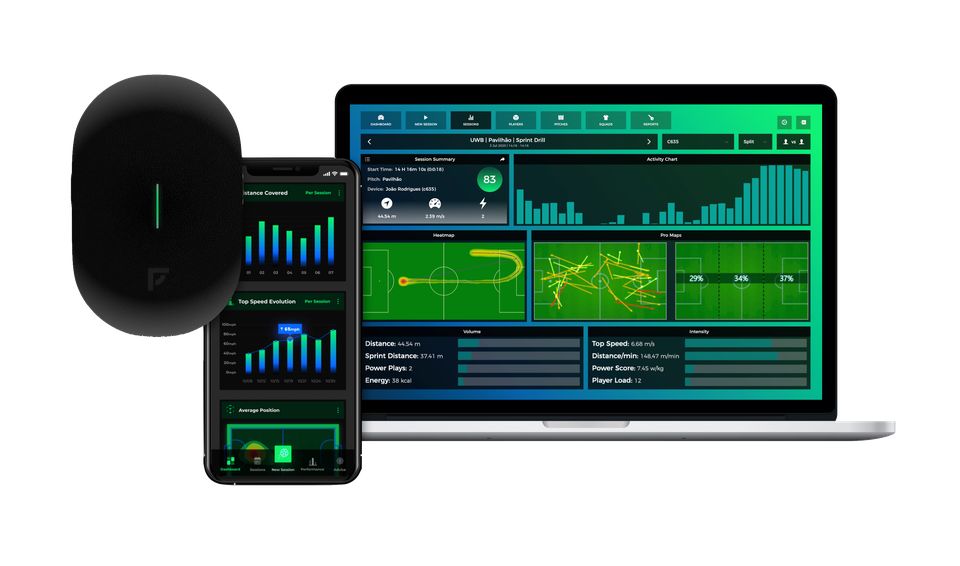
Field MINT is a high-precision sports tracking system that brings elite-level performance analytics to amateur athletes, teams, and leagues at a fraction of the cost. Combining GNSS (Galileo, GPS, GLONASS) for outdoor tracking and Ultra-Wideband (UWB) for centimeter-level indoor positioning, the wearable device enables real-time movement analysis, sprint tracking, heatmaps, and fatigue detection. Powered by Google Cloud (BigQuery, Firebase, Cloud Dataflow), data is processed instantly and visualized via interactive dashboards on web and mobile apps. AI-driven insights (TensorFlow, Google AutoML) provide player benchmarking, stamina analysis, and injury risk prediction, helping athletes refine their game. With a subscription-based model and session rentals, Field MINT reduced tracking costs by 90%, making elite-grade analytics accessible to all sports levels. Recognized by the European Space Agency (ESA) with a grant, Field MINT is a breakthrough in sports technology, leveraging satellite and AI-powered analytics to revolutionize performance tracking.
Challenges
- The sports industry lacked an affordable, high-precision sports tracking system that could serve lower-tier teams, amateur leagues, and recreational players. While elite sports teams used GPS-based tracking solutions, these were prohibitively expensive (+$15.000/player/year) and unsuitable for indoor sports. Indoor tracking was a significant technical hurdle since GNSS is ineffective indoors, requiring an alternative high-accuracy positioning method.
- The challenge was to develop a hybrid system that could:
- Provide centimeter-level accuracy both indoors and outdoors.
- Reduce costs to make high-performance tracking accessible beyond elite teams.
- Ensure scalability for leagues, clubs, and independent users.
- Deliver real-time analytics and historical data visualization for player improvement.
Solution
- To solve these challenges, we developed Field MINT, a high-precision wearable sports tracking device that leverages GNSS (for outdoor tracking), UWB (for indoor tracking), and advanced inertial sensors to measure:
- Acceleration, speed, sprint distance, heatmaps, and fatigue levels.
- Real-time positioning with an accuracy of ~30cm indoors and sub-meter accuracy outdoors.
- ML-powered movement analysis, providing insights on play intensity, stamina, and injury risk.
- Data from the device is streamed in real-time to Google Cloud, where it undergoes processing via Cloud Dataflow and is stored in BigQuery for historical trend analysis. The user-facing dashboards (web & mobile) present interactive visualizations, allowing players and coaches to review performance metrics, identify strengths and weaknesses, and compare player performance over time.
- To make the system widely accessible, we introduced a subscription-based model, drastically lowering the barrier to entry while ensuring teams and players had access to professional-grade analytics.
- Additionally, we launched a new revenue stream for the booking platform as a rental option, allowing users to rent the system per session without requiring upfront hardware purchases when booking a sports venue with Field.
Impact
- Achieved 30cm accuracy in indoor tracking, solving one of the biggest limitations of traditional GPS trackers.
- Amateur players onboarded across multiple sports during pilots, proving demand beyond elite teams.
- Reduced cost by 90% compared to competitors, making high-precision tracking accessible for all player levels.
- Subscription model drove predictable revenue, securing €1M+ in funding from investors and sports organizations.
- Awarded an ESA (European Space Agency) Grant, recognizing Field MINT as a breakthrough innovation in leveraging satellite technology for sports performance tracking.
How it was built
- HardwareGNSS (Galileo, GPS, GLONASS) & Ultra-Wideband (UWB) sensors for high-precision positioning.
- Embedded SystemsC++ firmware for real-time data capture and synchronization.
- BackendPython (FastAPI) for high-speed motion data processing and predictive analytics.
- Cloud InfrastructureGoogle Cloud Platform (GCP), utilizing BigQuery and Firebase for real-time ingestion, storage, and analysis.
- DatabaseNoSQL for user profiles and team management; InfluxDB for time-series motion data.
- Mobile & WebReact Native (iOS/Android) and React.js dashboards for performance visualization.
- AI & AnalyticsTensorFlow & Google AutoML for movement pattern recognition, player benchmarking, and injury risk prediction.
- Security & ComplianceEnd-to-end encryption, GDPR-compliant data handling, and secure multi-tenant architecture for team data segregation.
- MethodologiesAgile hardware-software co-development, iterative testing with athletes, and data-driven performance modeling.
Gallery


Contact
Before you commit the budget, let's make sure the plan makes sense.
Book a 30-minute call. We'll discuss the investment you're considering, the decisions you need to make, and whether the Sprint is the right fit.
Book a callThe booking will ask:
- What you're considering building or changing
- The approximate investment
- When you need a decision
Prefer email? Write to hello at pedrobalas dot com